
An Integrated Planning and Controls Environment
A schedule becomes a management tool only when it is connected to the way the project is governed and executed. APP develops an integrated control cycle:

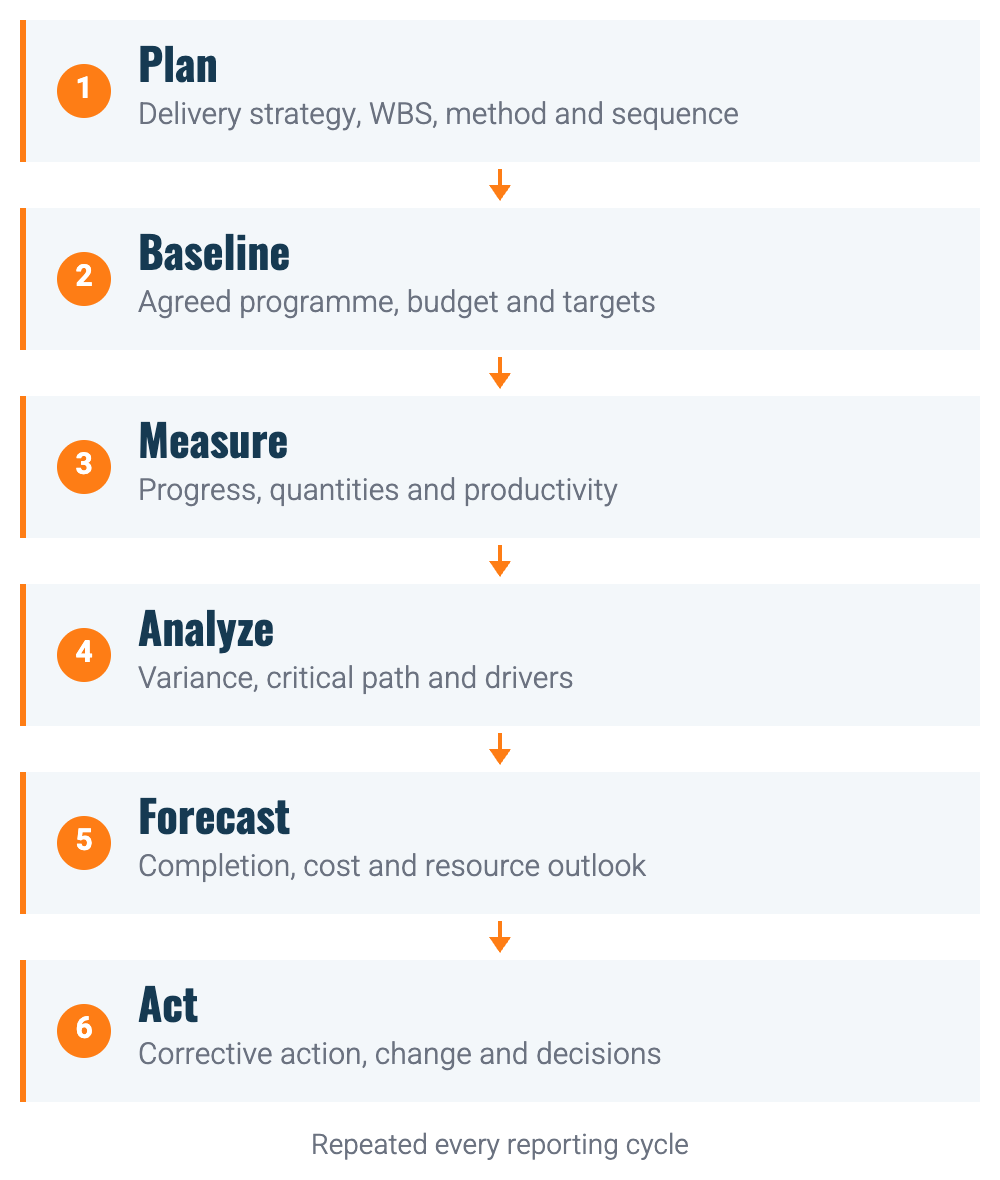
The cycle connects scope and work breakdown structures, contractual and internal milestones, design, procurement, construction and commissioning, resources, quantities and productivity, and the cost, risk and change processes that run alongside them.
To operate that cycle consistently, APP defines the structures, rules and reporting routines behind it:
- Planning and schedule management procedures
- Work, organization and cost breakdown alignment
- Programme hierarchy and coding structures
- Control accounts and reporting responsibilities
- Progress measurement rules
- Data-date and reporting cut-off procedures
- Baseline and change-control requirements
- Schedule update and approval workflows
- Interface, milestone and decision registers
- Integration with cost, risk and document-control processes
The controls environment is designed around the project’s contract, delivery model, complexity and existing systems rather than imposed as a generic template. The result is a planning environment that reflects the delivery strategy and remains current as the project develops.
Our Planning Methods
No single technique answers every planning question. APP combines four: CPM establishes the contractual and logical framework, lean planning turns it into commitments the delivery teams can meet, and linear and 4D planning add the location and spatial views a bar chart cannot show.
CPM Planning
Critical Path Method planning provides the logical framework for understanding sequence, dependencies, float and the activities controlling completion. APP develops and reviews CPM programmes covering:
- Design and approval activities
- Procurement and long-lead items
- Construction sequence and work fronts
- Contractual and sectional milestones
- Testing, commissioning and handover
- Contractor, subcontractor and third-party interfaces
- Access, permits and client decisions
- Resource and productivity assumptions
The programme is tested for logical integrity, constructability, milestone achievability and consistency with the proposed execution strategy. For employers, APP reviews contractor programmes and establishes integrated master and interface schedules. For contractors and joint ventures, we develop tender, baseline, update and recovery programmes aligned with contractual requirements and the intended method of delivery.
Lean Planning and Production Control
Lean planning translates the master programme into coordinated and achievable commitments for the teams delivering the work. APP establishes collaborative planning and production-control routines that connect design, procurement, construction and commissioning:
- Phase and pull planning
- Look-ahead planning
- Make-ready planning
- Constraint identification and removal
- Weekly work planning
- Daily coordination and production tracking
- Measurement of plan reliability
- Reasons-for-non-completion analysis
- Takt planning for repetitive work
- Continuous improvement reviews
Activities are screened for information, access, design, materials, labor, plant and predecessor requirements before they are committed for execution, and constraints are assigned to named owners with required resolution dates. Percent Plan Complete and reasons for non-completion are tracked to identify recurring workflow failures and improve the reliability of future commitments.
Linear and Time-Location Planning
Gantt charts do not show where work is taking place or how crews move through a project. For linear and repetitive work — railways and metro systems, roads and highways, tunnels, pipelines and utilities, transmission lines, marine and water infrastructure, and repetitive buildings and production areas — APP applies time-location planning to connect activities with geography, work fronts and production rates. It makes the following easier to analyze:
- Crew movement and separation
- Production continuity
- Access and right-of-way availability
- Possessions and traffic restrictions
- Environmental and permitting windows
- Crossings and geographical constraints
- Mass-haul and material movements
- Workspace conflicts
- Productivity and resource utilization
4D Planning and Constructability
4D planning connects programme activities with model components so that the proposed sequence can be examined spatially as well as logically. APP uses 4D planning to assess:
- Construction sequence and work packaging
- Site access and logistics
- Temporary works
- Crane, plant and material movements
- Work areas and workspace requirements
- Trade and contractor interfaces
- Constructability and safety considerations
- Alternative execution scenarios
- Planned and actual progress
A 4D model should not be treated as an animation. Its value comes from using the model and programme together to identify problems, test options and communicate the delivery strategy before the work reaches site.
Control Through Delivery
A programme cannot provide control unless its progress data can be trusted. APP establishes objective measurement rules using methods appropriate to the work — physical quantities, defined milestones, weighted activity steps, installed or completed units, approved deliverables, verified actual dates and remaining-duration assessments.
During each reporting cycle we examine progress against the approved baseline and current forecast. The review identifies:
- Movement in critical and near-critical paths
- Milestone slippage
- Changes in logic or sequence
- Out-of-sequence progress
- Productivity trends
- Delayed decisions and approvals
- Procurement and interface constraints
- Emerging risks to completion
Updates are validated against project records and site conditions rather than accepted as administrative submissions. The resulting forecast shows both the current status and the work still required to complete the project.
Planning is coordinated with the wider controls environment so that the programme, cost forecast, risk register and change process do not produce conflicting views of the same project. Common coding, defined data ownership and coordinated reporting cycles let the project team see:
- What has changed
- Why performance has moved
- Which milestones are exposed
- What the current forecast means for cost and resources
- Which actions or decisions are required
- Who is accountable and by when
The objective is not to generate more reporting. It is to ensure that each report leads to an informed action or decision.
Schedule Assurance and Recovery
APP reviews baseline and update programmes for contractual compliance, technical integrity and suitability as control tools. The assessment may cover:
- Missing or open-ended logic
- Excessive constraints and lags
- Unrealistic activity durations
- Calendar inconsistencies
- Negative or excessive float
- Progress and data-date anomalies
- Out-of-sequence work
- Unexplained logic changes
- Critical and near-critical path stability
- Resource and productivity assumptions
- Alignment with contemporaneous records
Findings are prioritized according to their effect on the reliability of the programme and forecast.
When performance moves away from plan, APP develops and tests practical recovery options:
- Resequencing and alternative work fronts
- Revised access or procurement strategies
- Resource and shift changes
- Productivity improvement measures
- Parallel working and sectional completion
- Removal of decision or interface constraints
- Targeted acceleration
Each scenario is assessed for feasibility, time benefit, resource implications, cost exposure and execution risk before it is adopted.
Typical Services and Deliverables
Depending on the appointment, APP’s scope may include:
- Planning and schedule management plans
- Work breakdown and coding structures
- Tender and execution planning
- CPM baseline development
- Contractor programme review
- Integrated master and interface schedules
- Design and procurement schedules
- Progress measurement systems
- Periodic updates and forecast reporting
- Lean planning, pull and look-ahead planning and constraint management
- Linear and time-location planning
- 4D sequencing and constructability reviews
- Schedule quality and maturity assessments
- Recovery and acceleration scenarios
- Planning dashboards and executive reporting
Technology Applied to the Method
APP works across established planning and project controls platforms, including Oracle Primavera P6, Oracle Primavera Cloud, Primavera Unifier, Asta Powerproject, Microsoft Project, Deltek Open Plan, Tilos, compatible 4D environments and others.
Technology is selected to fit the project’s delivery and reporting requirements. The planning method, governance and quality of the project data remain more important than the software used to present them.