


Delay Analysis, Claims & Dispute Avoidance

Clear records. Defensible analysis. Earlier resolution.

Delay and claims cannot be resolved by a schedule comparison or cost calculation alone. A defensible position requires contractual obligations, contemporaneous records, programme logic, cause-and-effect analysis and substantiated cost to form one consistent case.

APP provides delay, quantum and claims analysis throughout the project lifecycle for employers, contractors, consultants and joint venture teams, with our responsibilities defined by each appointment.

A Claim Is a Chain of Proof

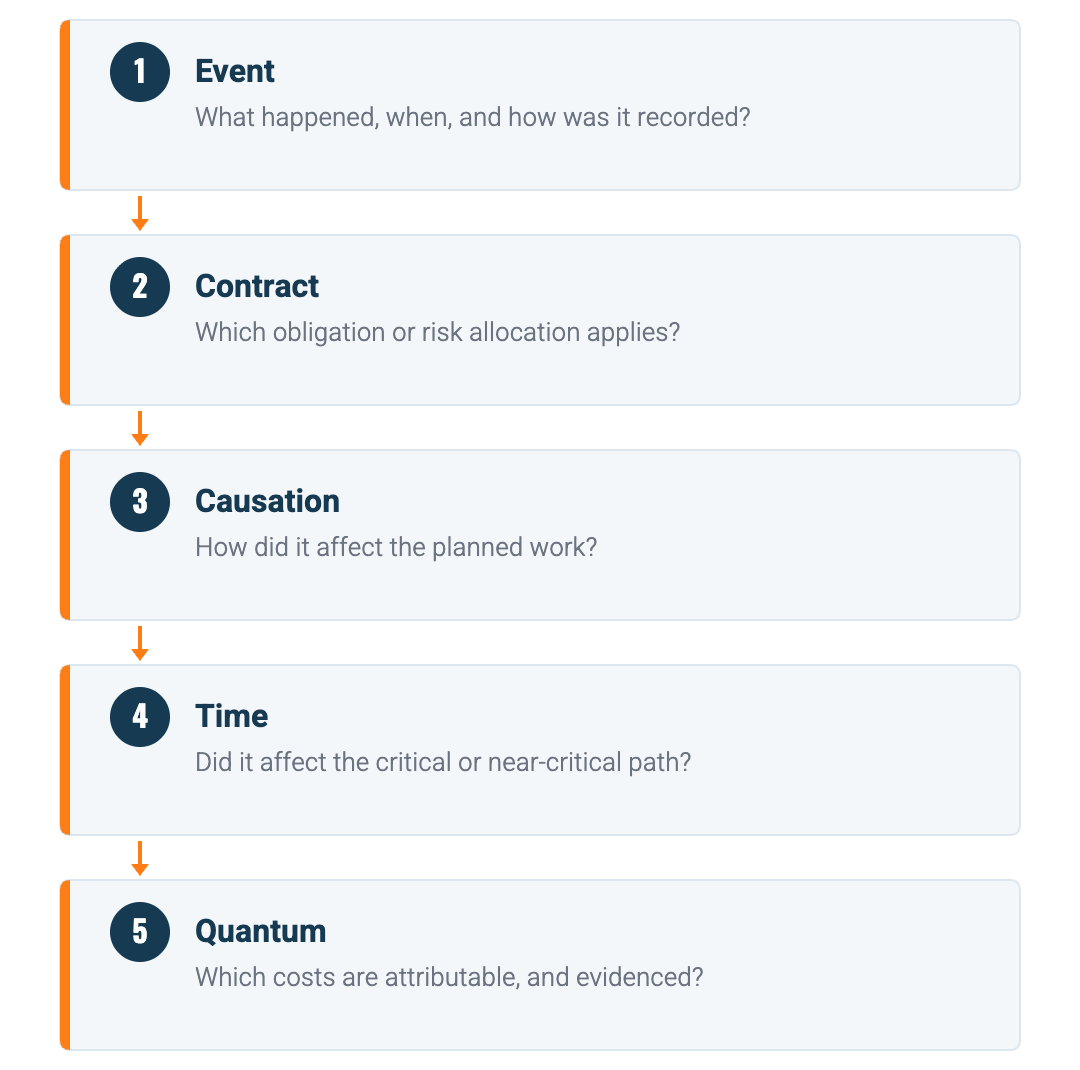
Our role is to establish what happened, determine its effect on time and cost, test the available evidence and present the findings in a clear, auditable form. A credible claim or response must answer five connected questions; if one link is missing, the position becomes harder to defend.

Event, contract, causation, time and quantum, each with the question it must answer.

Our Integrated Analysis Process

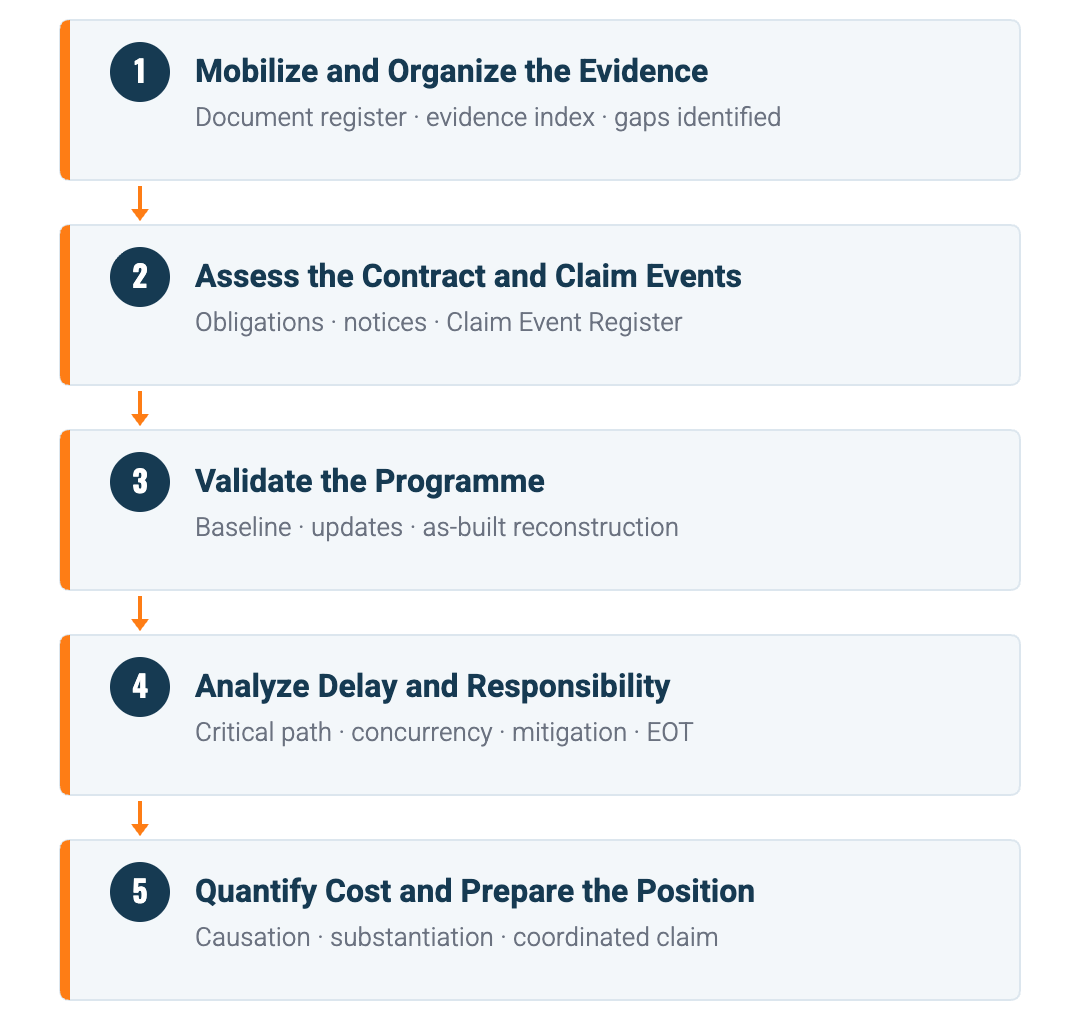
Five stages of the claims analysis process.

1. Mobilize and Organize the Evidence

We establish a controlled review environment covering the contract, programmes, progress records, notices, correspondence, drawings, daily reports, resource data and cost records. A document register and evidence index are developed alongside an Observation, Question and Request register to identify missing or inconsistent information at the start rather than at the end.

2. Assess the Contract and Claim Events

We review the contractual procedures, obligations, risk allocation and notice requirements. Each event is recorded in a Claim Event Register linking relevant dates and contractual basis, responsible parties and interfaces, notices and correspondence, alleged cause and effect, potential time and cost consequences, and the available evidence and identified gaps. We also test likely counter-positions before a claim or response is finalized.

3. Validate the Programme

Before relying on a programme we examine baseline logic and contractual milestones, calendars, constraints and relationships, data dates and progress integrity, actual and remaining durations, out-of-sequence progress, logic changes between updates, critical and near-critical paths, and consistency with the contemporaneous records. Where necessary and supported by the records, we reconstruct the actual sequence of work and document the assumptions applied.

4. Analyze Delay and Responsibility

The analysis considers the critical path as it stood when each event occurred, changes in criticality during delivery, employer, contractor and neutral events, concurrent delay, mitigation and recovery, acceleration, pacing and resequencing, and the resulting extension-of-time entitlement. The methodology is selected according to the contract, the project facts, the purpose of the assessment and the quality of the available data.

5. Quantify Cost and Prepare the Position

The identified events and delay periods are connected to the relevant cost records. Normal project expenditure, unsupported amounts, duplication and overlapping cost categories are separated from demonstrable additional cost. The contractual basis, chronology, programme analysis and quantum are then brought together in one coordinated claim, assessment or response.

Delay, Disruption and Cost

Delay Analysis

Delay analysis may be undertaken prospectively during delivery or retrospectively after the effects have occurred. Depending on the circumstances we may apply time impact analysis, windows or time-slice analysis, as-planned versus as-built, impacted as-planned, collapsed as-built, or a combined or period-specific approach. No method is automatically suitable for every project: the choice must reflect the contract, the available records, the nature of the events and the level of detail required. Our analysis examines how the programme developed, when criticality shifted, and whether the alleged delay can be traced to the event being assessed.

Delay and Disruption Are Not the Same

A project may finish late without demonstrating productivity loss, and it may suffer disruption without the affected work delaying completion. Delay analysis examines the effect of events on milestones and completion; disruption analysis examines the loss of productivity or efficiency. Where disruption is alleged we assess resource records, planned and actual productivity, sequencing, access restrictions, repeated mobilization, trade interference and the effects of change.

Quantum and Cost Analysis

A time entitlement does not automatically establish compensation. The cost analysis must demonstrate which costs were caused by the relevant event or delay period. Depending on the contract we may assess direct costs arising from change, prolongation and time-related site costs, labour, plant and equipment standing time, acceleration and recovery costs, disruption and productivity loss, subcontractor and supplier costs, and escalation and procurement impacts. Claimed amounts are tested against timesheets, invoices, plant records, cost reports and payment evidence, with causation, timing, mitigation, reasonableness and contractual recoverability considered. The output is an auditable quantum workbook with clear source references and calculation logic.

Delay: effect on milestones and completion. Disruption: loss of productivity. Cost: which amounts are caused by the event and evidenced.

Claim Preparation, Review and Response

APP structures claim submissions around the contractual and procedural basis; the factual chronology and claim events; cause-and-effect analysis; programme and delay assessment; quantum and substantiation; and mitigation and requested relief. The narrative, programme analysis and quantum are cross-checked for consistency.

When reviewing a claim, we test the notice procedure, chronology, programme records, critical-path conclusions, concurrency, mitigation, cost causation and evidential strength. The assessment distinguishes between substantiated, partially substantiated and unsupported elements, and identifies the information required to resolve the remaining issues.

Claims Prevention and Dispute Avoidance

Claims prevention begins before construction and continues throughout delivery. The objective is to stop unclear responsibilities, missing records and unmanaged events from developing into avoidable disputes.

Much of what is later argued can be settled in the contract itself: who owns float, which method of delay analysis applies, how site and head office overhead are calculated, how standing plant is valued. Where those are left undefined, the same facts produce materially different answers. We recommend defining them before award, and where APP is engaged early we provide that drafting input.

APP can establish and operate:

  • Scope and interface responsibilities
  • Practical risk allocation
  • Programme and progress requirements
  • Contract-specific notice calendars
  • Early-warning and claim-event registers
  • Change and instruction tracking
  • Document and record protocols
  • Delay and impact assessments
  • Extension-of-time workflows
  • Mitigation and recovery monitoring
  • Regular commercial and claims reviews

Early, written and evidence-led assessment gives the parties a better opportunity to resolve issues while the relevant records and project knowledge remain available.

Typical Deliverables

  • Document register and evidence index
  • Observation, Question and Request register
  • Claim Event Register
  • Notice and obligation matrix
  • Factual chronology
  • Entitlement and evidence-strength assessment
  • Programme-quality review
  • Validated or reconstructed as-built programme
  • Delay-analysis methodology and model
  • Extension-of-time assessment
  • Disruption and productivity analysis
  • Quantum audit and calculation workbook
  • Claim submission or response report
  • Executive findings and negotiation briefing

Standards-Informed and Contract-Specific

Our work is informed by recognized guidance, including AACE International Recommended Practice 29R-03 on forensic schedule analysis and the Society of Construction Law Delay and Disruption Protocol, whose position is that entitlement should be assessed contemporaneously rather than left to the end of the project.

Where FIDIC, NEC4 or another standard form is used, the analysis is aligned with the applicable edition, amendments and project-specific conditions. The mechanisms differ in kind, not only in wording: FIDIC turns on notice, particulars and determination, while NEC4 runs on early warnings, compensation events and an accepted programme, where late notification can extinguish entitlement altogether. Notice periods and entitlement provisions are confirmed against the governing contract rather than assumed.

APP provides technical, programme, quantum and contractual analysis. Where legal interpretation is required we work alongside the client’s appointed legal advisers, and expert appointment or testimony is agreed separately where required. We do not create records that do not exist: where the evidence does not support a position, we say so before it is submitted.

Establish the Record Before the Dispute

The strength of a claim is usually determined before the final report is written. Engage APP to establish the evidence, analyze the programme, quantify the effect and develop a position capable of withstanding technical, commercial and contractual scrutiny.