
EcoDomus — Digital Twin & Lifecycle Facility Data
Siemens Smart Infrastructure
EcoDomus connects the asset information model produced during design and construction to the systems that actually run the building — maintenance management, building automation, GIS and document control — so that the data handed over at practical completion stays useful for the whole life of the asset.
Status: in December 2021 Siemens Smart Infrastructure acquired the EcoDomus digital twin software, and the capability now sits inside Siemens’ smart-building portfolio. APP delivers the same outcomes on EcoDomus through partner deployments and on equivalent platforms such as Autodesk Tandem — see Asset Information, Handover & Lifecycle Data Management.
What the platform does
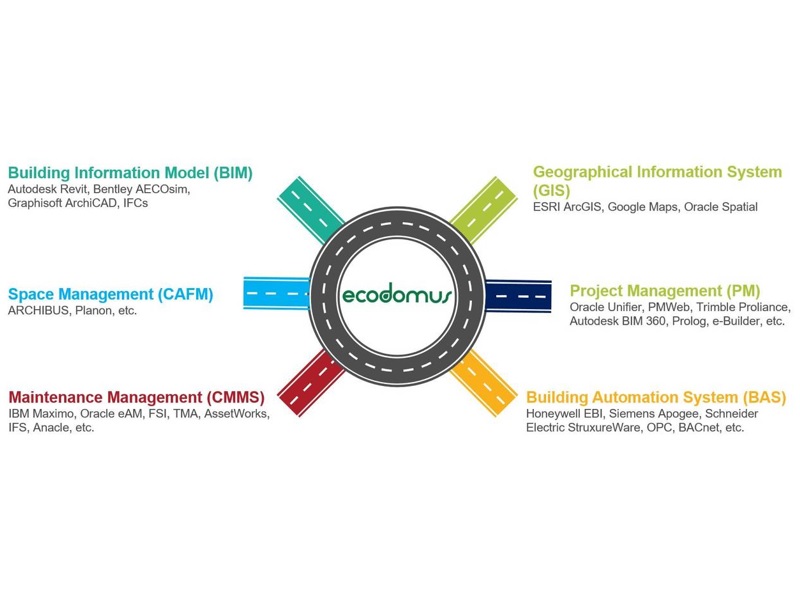
Lifecycle information never lives in one system. Geometry is authored in BIM tools, specifications and submittals accumulate in project systems, commissioning and maintenance data sit in CMMS or CAFM, spatial data comes from GIS and live values come from sensors. EcoDomus does not try to replace any of them — it connects them and presents one unified asset information model on top.
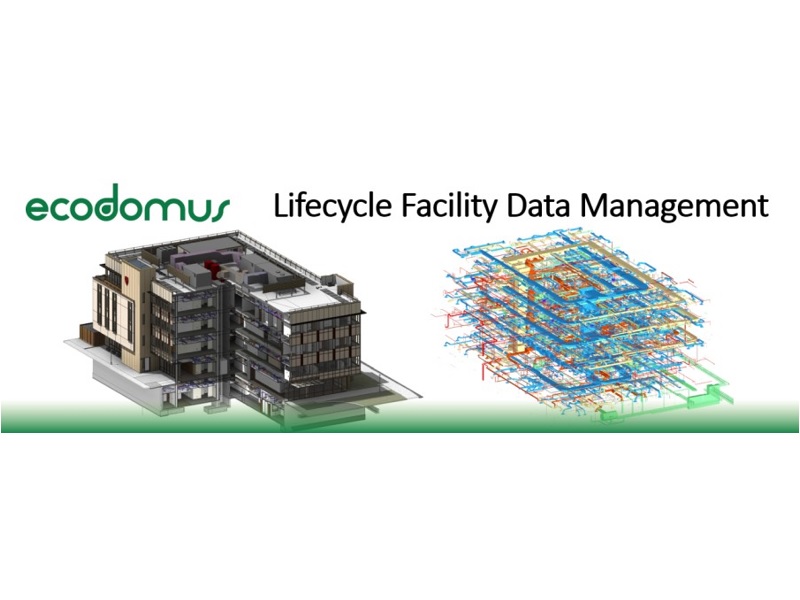
- A single-source-of-truth asset database with a 3D interface for collection, validation and maintenance of asset data
- Integration with building automation systems (Siemens, Honeywell, Johnson Controls and others)
- Integration with CMMS / CAFM / IWMS platforms such as IBM Maximo, ARCHIBUS, AssetWorks AiM, Accruent FAMIS and TMA webTMA
- Integration with GIS — ESRI ArcGIS and Google Earth
- Support for open information standards, COBie in particular
- Web and mobile interfaces for site-based working
- Cloud or on-premise deployment behind a private firewall
- Scalability toward IoT and large-scale sensor data
Capabilities
Common Data Environment
Documents managed by metadata, with check-in and check-out for editing, tag-based filtering, defined workflows and document-to-asset linking under COBie rules. Aligned to ISO 19650 common data environment practice.
COBie Collection & Validation
COBie data is captured and checked through both a browser form interface and a 3D interface, so information can be verified against the model it describes rather than in a spreadsheet alone.
3D Navigation & BIM API
Browser-based navigation of mechanical, electrical and plumbing systems, with linked datasheets and photographs. Point clouds from laser scanning can be viewed alongside the model, with measurement between any two points.
BIM and Building Automation
Automation system data is tracked inside the 3D environment, so HVAC performance can be examined element by element instead of through a separate trend screen.
Mobile Capture in the Field
Properties of model objects reviewed and edited on site from a phone or tablet: photographs and documents attached, barcodes scanned to locate an object in 3D, punch list and snag items raised where they are found.
Portfolio View & Reporting
Assets filtered by location or discipline and viewed on a map, combining BIM and GIS. Custom reports cover finish schedules and quantities, fire ratings for walls and doors, and their position on the floor plan.
Enterprise deployment
Deployed across an organization, the platform becomes a central facility repository — the aggregator that holds or connects every lifecycle data source at element level. The value is not the viewer; it is that the customer’s existing databases are integrated well enough to be analyzed together.
How APP applies it
Software alone does not produce a reliable asset information model. What produces it is a defined set of information requirements, a data collection process the supply chain can actually follow, validation at each gateway, and a handover that the operator accepts. APP does that work — on EcoDomus, on Autodesk Tandem, or on the platform the client already owns.
- Asset Information, Handover & Lifecycle Data Management — the service this platform supports
- BIM Management & Digital Delivery — model production and coordination upstream of handover
- Project Document Management, Control & CDE — the document side of the same common data environment