
PMO Design, Implementation & Management
A PMO that governs delivery—not just reports it.
APP designs, mobilizes and operates Project Management Offices that connect organizational objectives with project and programme delivery.
Working with owners, consultants and contractors, we establish the governance, integrated controls, management information and performance routines required to direct delivery across individual projects, major programmes and portfolios.
Depending on the engagement, APP can establish a new PMO, strengthen an existing function or manage the agreed PMO scope as part of the client’s organization or integrated delivery team.
Built Around Value and Delivery
A successful PMO is not measured by the number of templates it produces or reports it distributes. Its value lies in the quality of the decisions it enables, the delivery discipline it establishes and its ability to identify where management action is required.
A PMO stops being used for predictable reasons: its mandate was never written down, so its authority is contested; it asks for data it does not use, so reporting becomes a tax; or its information arrives after the decision it was meant to inform. We design against those failures explicitly and test for them at the assurance reviews, not at the end of the engagement.
A PMO Designed for Its Mandate
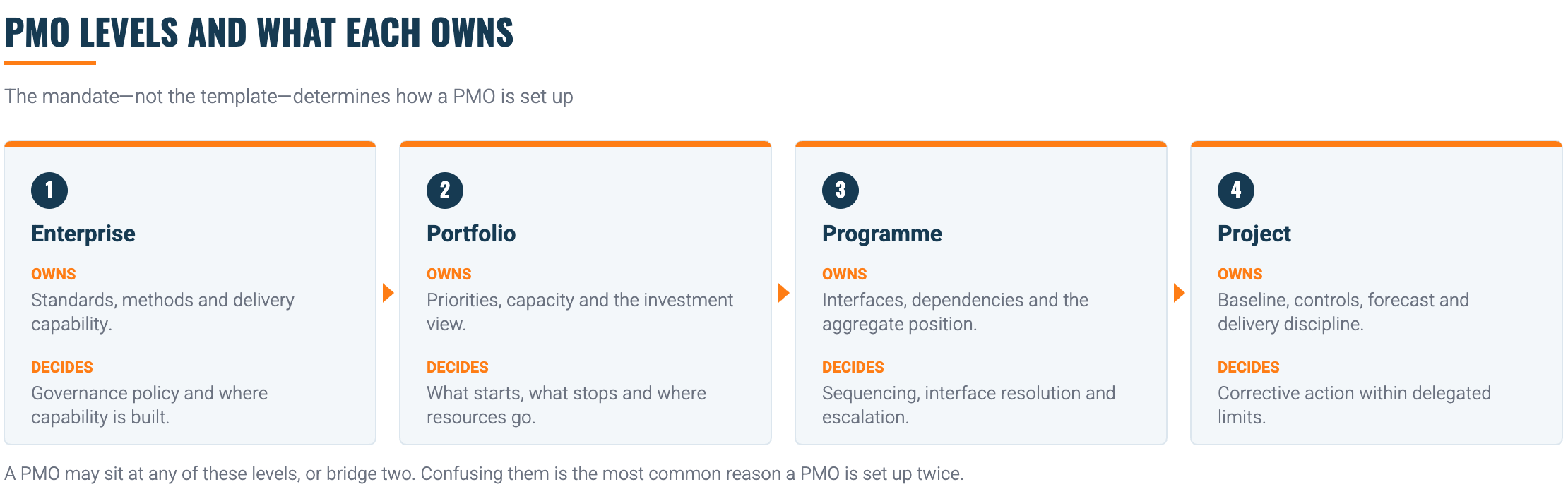
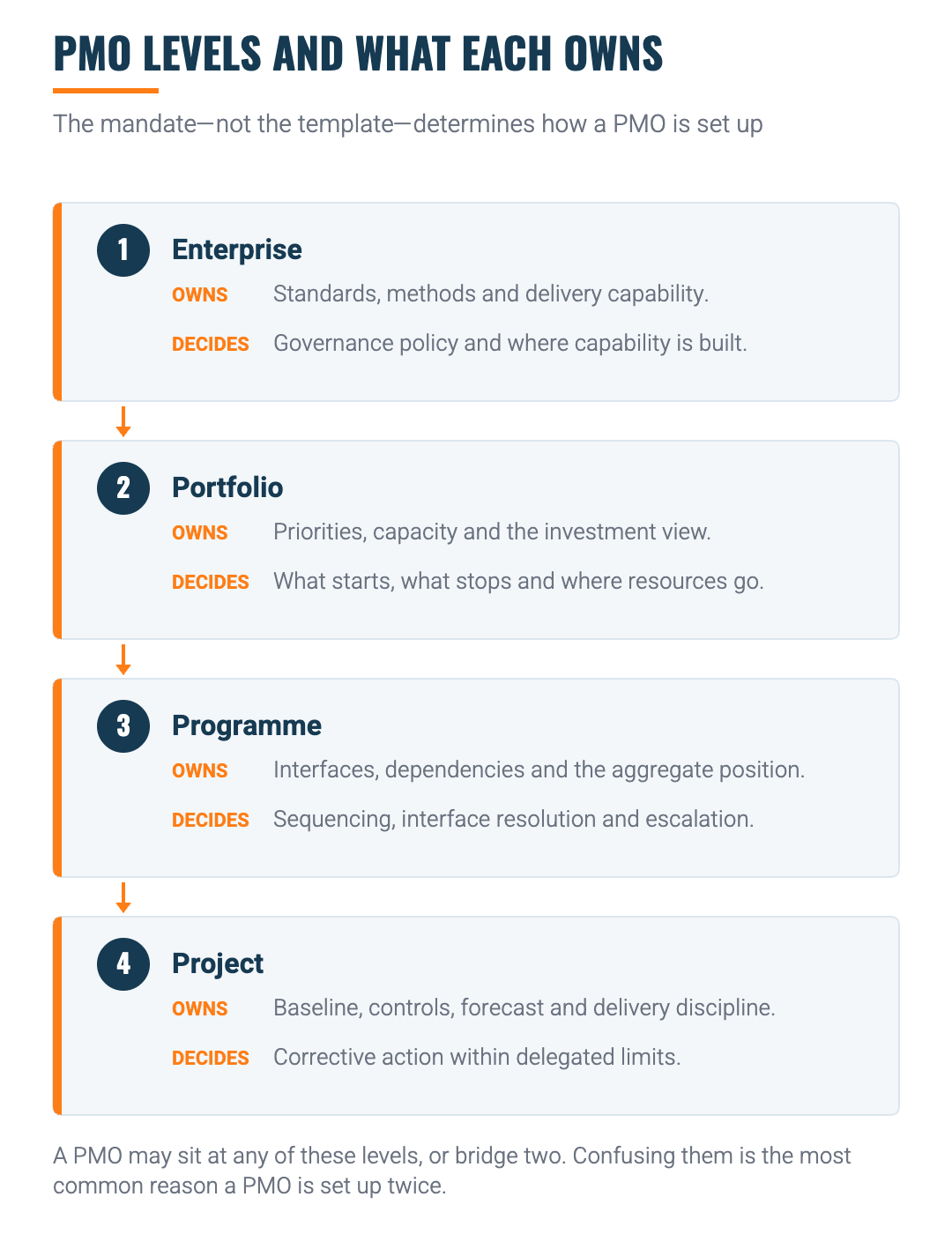
There is no single PMO model suitable for every organization or project. A PMO may operate at enterprise, portfolio, programme or individual-project level. It may be established as a permanent organizational function, a temporary programme office or an integrated team responsible for managing a defined delivery scope.
APP defines the PMO’s mandate before developing its procedures and systems. This establishes:
- Why the PMO is being created
- What outcomes it is expected to influence
- Which projects and programmes fall within its authority
- What decisions it can make or recommend
- What information it requires
- When matters must be escalated
- How its performance and value will be measured
This prevents the PMO from becoming an administrative reporting layer without the authority or information required to influence delivery.
Our PMO Implementation Approach
1. Assess the Delivery Environment
We assess current governance, delivery practices, controls, systems, reporting, capability and decision-making, identifying overlapping responsibilities, inconsistent processes, unreliable data and reporting that does not lead to management action. The objective is not an abstract maturity score; it is to establish what the organization needs the PMO to do, and what has to change for it to do it.
2. Define the PMO Mandate and Value
With sponsors and delivery stakeholders we set the PMO charter: objectives, scope, authority, customers, services, reporting lines and interfaces. Success measures are tied to delivery performance rather than activity—decision turnaround, forecast reliability, governance compliance, delivery confidence and the timely resolution of escalated matters.
3. Design the Operating Model
We define the governance bodies and management forums, decision rights, delegated authorities and escalation routes, the project and programme lifecycle, stage-gate and assurance processes, reporting cycles, and the interfaces to finance, procurement and commercial functions. Systems and data requirements are specified here and configured around the operating model—technology is not a substitute for it.
4. Establish Delivery Standards and Controls
A proportionate delivery framework is implemented across initiation, scope, schedule, cost, risk, change, quality, resources, procurement interfaces, benefits and closeout—as connected controls, so a movement in one area is visible in the wider forecast. The framework supports predictive, adaptive and hybrid approaches, with the level of governance set by project scale, complexity, risk and contractual obligation.
5. Mobilize the PMO
We move the operating model into daily use: the team is mobilized, procedures issued, reporting cycles started, systems and dashboards configured, governance calendars established and active projects brought into the agreed control environment. Initial reporting is tested against source information before it enters the formal management cycle, and roles and deadlines are set for submission, review, challenge, approval and escalation.
6. Operate and Govern Delivery
Where included in the engagement, APP runs the agreed PMO functions and governance cycles: consolidating and challenging project information, maintaining the integrated view of delivery, and ensuring decisions, actions and escalations are followed through. Reporting is structured around the decisions required at each governance level—current status, emerging exposure, forecast outcome and the action required.
7. Measure, Adapt and Improve
The PMO’s own services are reviewed against their intended outcomes: whether governance is enabling timely decisions, whether project information is reliable, and whether management action is improving delivery performance. Procedures, reporting and controls are adjusted as the portfolio and delivery environment change, and lessons learned are converted into updates to governance, planning assumptions, templates and benchmarks.
8. Embed Capability and Transfer Responsibility
Where the PMO is intended to become an internal function, we prepare the organization to operate it: role definitions, competency development, coaching, operating manuals, process ownership and system administration, followed by a structured transfer of responsibilities. What is handed over is an operating PMO with established routines, accountable process owners and an improvement roadmap—not an organization dependent on continued consultancy involvement.
Our PMO Services
- PMO strategy, charter and implementation roadmap
- PMO operating-model design
- Enterprise, portfolio, programme and project PMOs
- PMO mobilization and operational management
- Governance, decision-rights and delegated-authority frameworks
- Stage-gate, assurance, health-check and transformation processes
- Portfolio and programme coordination
- Dependency, interface and resource management
- Project delivery methods and lifecycle standards
- Business case, initiation and scope-control requirements
- Integrated planning, cost, risk and change controls
- Performance measurement and executive reporting
- Owner-side review of contractor and consultant reporting
- Benefits identification, realization and tracking
- PMO systems, data and workflow implementation
- Management dashboards and business intelligence
- Competency development and knowledge transfer
- PMO transition and structured handover
Standards-Informed, Delivery-Led
Our approach is informed by recognized Project Management Institute standards and guidance, including:
- Project Management Offices: A Practice Guide
- The Standard for Project Management and the PMBOK® Guide
- The Standard for Organizational Project Management
- The Standard for Program Management
- The Standard for Portfolio Management
- Benefits Realization Management: A Practice Guide
These references provide a foundation for governance, value delivery, accountability, performance management and continuous improvement, and where a client’s contractual environment calls for it we also work to ISO 21502. PMI standards provide the reference framework; the project environment determines how that framework should be applied.
APP applies them proportionately, adapting the PMO to the organization’s objectives, contractual environment, delivery model and existing capabilities. The result is a PMO that is proportionate to its mandate, integrated with the organization and accountable for the management processes within its agreed scope.
Build the Management System Behind Delivery
Work with APP to design, implement or operate a PMO that connects governance, project controls and management decisions across your projects and programmes.